 Dream Journal Ultimate
Date: 6/29/2026
By KayDeeKay
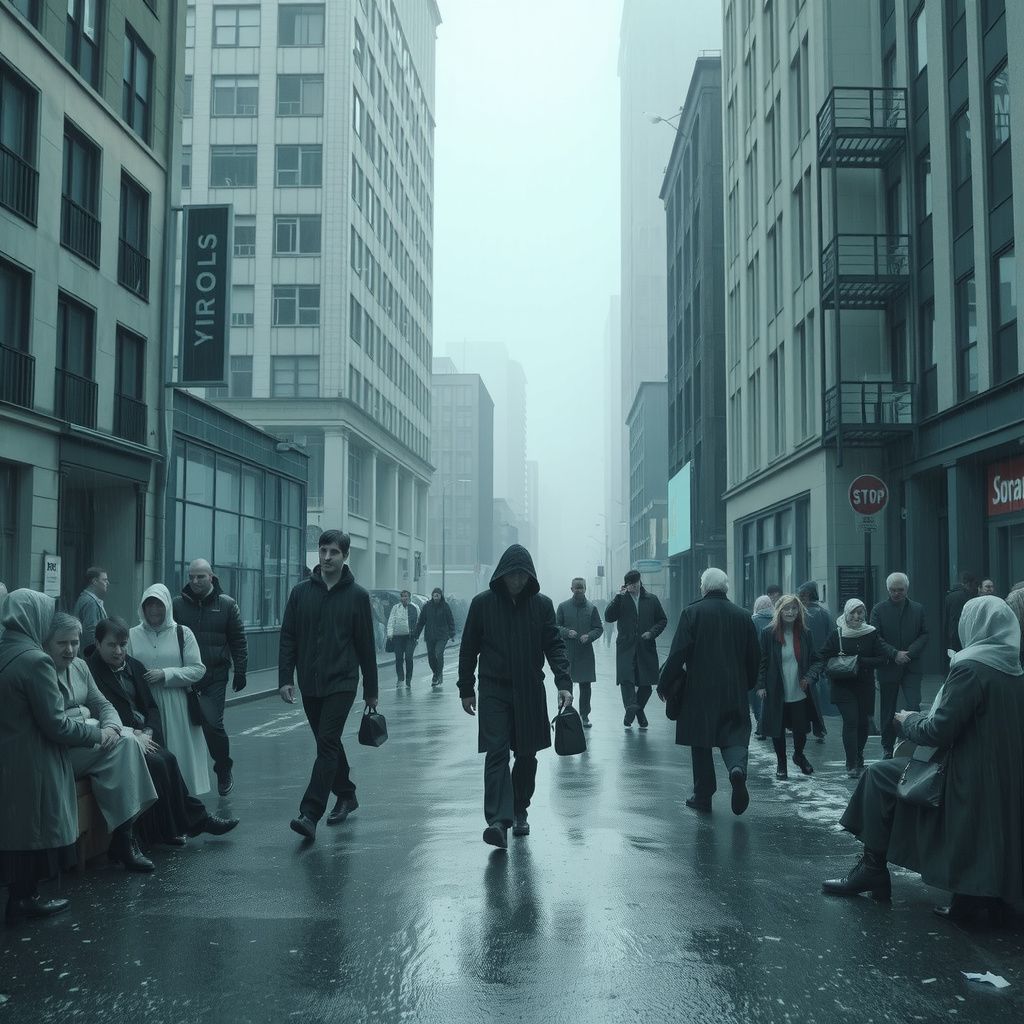
The dream took place across an unfamiliar city where I was traveling with different groups of people, all trying to solve some vague problem. I never fully understood what was happening, but everyone around me behaved in an incredibly strange way. No matter what I said, people would somehow hear something completely different. It felt like I was being gaslit by the entire world. For example, I would make a simple statement or ask a straightforward question, and the person next to me would confidently repeat something that had nothing to do with what I had actually said. It was as if my words were being translated into nonsense before anyone else heard them. The more I tried to clarify myself, the more convinced everyone became that I was the one who was confused. As the dream continued, my frustration grew. At one point I had to take an incredibly difficult history quiz, supposedly about military events during World War II. The teacher was portrayed as some famous, highly respected instructor, but nothing about the test made sense. The questions were impossibly obscure, and every answer I tried to give felt wrong. Even worse, reality itself refused to cooperate. I would finish the quiz and hand it directly to the teacher, only for her to insist I had never turned it in. Then she would produce an entirely different stack of papers and claim it was mine. The answers on the pages were complete nonsense—things like simply writing "7" for a complicated history question. I kept insisting that wasn't what I had written, but no one believed me. My mom appeared briefly and told me to call her when the quiz was over, and reminded me that this quiz was to honor these war heros and some ceremony would happen later that I had some role in ---but then she disappeared. Eventually I ended up in a hospital, where the same pattern continued. The staff treated me as though I were pretending to be sick or hiding something. If I asked to use the restroom, they assumed I was trying to smuggle medication or sneak away. Every explanation I gave was twisted into something entirely different. It felt like going to the hospital for a cold, only to have the doctors insist I needed surgery to remove my left hand. I kept saying, "That's not why I'm here," but nobody listened. They would come back with bizarre diagnoses that had absolutely nothing to do with what I had actually said. I tried contacting my family, but even that became impossible. Whenever I dialed my parents' phone number, the numbers would somehow change, or the call would connect to a completely different person. My phone battery kept getting lower, and I spent much of the dream searching for a charger, but every attempt failed. I knew that once my phone died, I would lose my only connection to reality. I eventually reached my sister, who took me to the hospital. At first she seemed to understand what was happening and believed me. But once she was around the doctors and other people, she suddenly started agreeing with them instead. It was as though everyone who spent enough time in that world became infected by the same distorted way of thinking. Knowing my dad is a news reporter in real life, I thought maybe I could find him somewhere in the city while he was covering a story. I hoped he would believe me and help me escape, but he ended up the same as my sister. It was like he understood when he picked me up then progressively lost his reason to the point he thought I was some random person trying to talk to him. Near the end of the dream, a stranger picked me up and insisted that I was their daughter. They already had around ten children crammed into one vehicle, and they spoke with complete certainty. I kept telling them they had the wrong person, but, just like everyone else, they ignored what I actually said. Throughout the entire dream, every interaction followed the same impossible pattern. Whatever I said became something else by the time another person heard it. Every attempt to explain myself only made people think I was stranger, more irrational, or mentally unstable. By the end, I genuinely feared I would never escape this world. I imagined becoming homeless because I would never be able to ask anyone for help. Every request would be misunderstood. Once my phone finally died, I would have no way to contact my family, no way to prove who I was, and no way to leave. I hoped that maybe strangers would eventually take pity on me, because I couldn't imagine surviving otherwise. The setting was this cold rainy like day. I started to hide and take these strange back routes to avoid people. Every conversation, every attempt to solve a problem, every effort to ask for help ended the same way—with my words transformed into something I had never said, leaving me completely isolated in a world where no one could understand me. My last thought was that someone is going to accuse me of murder and I'd get arrested.
AI generated interpretation Your dream centers on a powerful, recurring feeling: that reality itself is turning your voice into something alien. That constant mishearing and mistranslation—people hearing nonsense when you speak, your words becoming evidence against you—creates an experience of isolation and erosion of agency. Emotionally this reads like sustained frustration that grows into fear: frustration at being misunderstood, helplessness as others insist your experience is wrong, and a slow slide into dread that you will be trapped in a world that refuses to recognize you. The cold rainy city and the back routes you take underscore a mood of bleakness and withdrawal, suggesting that you’re trying to protect yourself from an environment that feels hostile and incomprehensible. Symbolically the scenes with authority figures—the revered teacher, the hospital staff—point to pressure from external standards and institutions. A history quiz about World War II, with impossibly obscure questions and nonsense answers, can stand for inherited narratives or expectations you’re being judged by but don’t own: cultural, familial, or professional standards that feel arbitrary or unfair. Jungian language would frame those authorities as aspects of the collective or the persona—roles and expectations placed on you by society that don’t align with your inner truth. Freudian ideas might highlight the anxiety around speech and expression—the fear that what you say will be warped or censored, leaving your conscious intention divorced from how others receive you. The hospital scenes intensify the theme of being pathologized: instead of being heard, you are treated as someone who is pretending, hiding, or in need of correction. The bizarre suggestion of removing your left hand reads like a fear of losing a capacity you rely on—agency, creativity, or practical competence. Your phone and its failing battery act as a modern tether to identity and proof: losing it threatens your ability to reach the people who validate you and to maintain continuity with your waking life. Family members who initially support you but then “catch” the world’s distorted logic point to anxieties about betrayal or contagion—the sense that even close allies can be swayed and that your reality may not be defended by those you expect. Archetypally, the dream pulls together the trickster or deceiver motif (the world that reinterprets your words), the shadow (the crowd’s distorted logic that you don’t recognize as your own), and the lonely hero motif (you navigating unfamiliar streets, trying to hold to your truth). Psychologically it mirrors experiences of gaslighting and social invalidation: feeling that others rewrite your intentions, doubt your competence, or reinterpret your words as evidence of instability. In waking life this can appear as conflicts where you feel repeatedly misunderstood, institutional frustrations (bureaucracy, medical systems, schooling), fear of being publicly misrepresented, or deep tiredness from trying to correct miscommunication that never sticks. As an invitation, the dream is asking where in your life you feel unheard and where you’ve begun to protect yourself by withdrawing. It may help to tend to small, concrete anchors: preserving ways to document your thoughts, naming specific moments where you felt overridden, and creating safe conversations with people who reliably listen. Reflective practices—journaling the exact phrases you wanted to convey, rehearsing boundary statements, or noting particular patterns in relationships—can help you distinguish what belongs to you from what the “world” projects. Above all, the dream is vivid proof that your inner sense of being misread matters; treating that experience with curiosity rather than only frustration can open the path to clearer communication and restoration of agency.